Monday, September 15, 2008

Calendulas


When I first started with Aromatherapy, I kept reading about the amazing healing and soothing powers of Calendula for skin. Unfortunately, there is no Calendula essential oil, just too hard to produce, I would think. A tiny little 20 gram tube of Calendula cream can set you back twenty or so dollars and wouldn't last all that long anyhow. So I learned to live without...until I got a garden. The plants themselves are very hardy and self-seeding. I can usually see them popping up around April, which is awfully early around here for anything to even start thinking of growing.

I found out Calendula flowers can easily be infused in oil. The oil absorbs the Calendula's healing properties and I can use it in remedies, lotions and creams. Most of my lotions and creams have about 20 - 50 per cent Calendula oil in them. I think it's great stuff.

Calendula flowers are easy to dry, just pick the whole flower and put 'em on newspaper until the petals practically fall off. They say the darker the petal, the more medicinal it is so I like the double, dark orange blooms. The only way I use them fresh is when my daughter needs some for her skin care. I steep some calendula petals in with some green tea and she uses it as a toner, it does seem to really help the problems of teenage skin. Sometimes for an extra boost, I'll add a couple of drops of lavender essential oil.

I find infusing them is a piece of cake. Once the petals are completely dried, I put them in a jar and top it off with organic cold pressed olive oil. Fresh petals can be used instead of dried but then I'm mucking around with trying to syphon off the water from the fresh petals and if I don't get it all, there can be a mold issue, which I'd rather not deal with. Once the petals are in the oil, I put the jar in on a sunny window sill and or on top of a heat vent and shake once a day. And voila, two weeks later, I have a lovely golden oil that pretty much will keep until the next harvest. All I do is strain it, squeezing every drop of that lovely oil out of the petals and keep it in the fridge.


disclaimer: This is how I use calendula for Aromatherapy, I am not recommending you do the same.

Sunday, September 14, 2008

First Worm Castings

My little Dendrodrilus Ribidus are doing very well. The bin seems happy and full of life. I am seeing a lot of worm cocoons and little tiny worms so I'm guessing all is well now. I did have a bit of an issue a little while ago when I change the bedding. I used brown leaves that I soaked in water then drained for their bedding. I obviously didn't check the leaves well enough and I discovered a couple of centipedes in the bin a few days later. Centipedes are a no-no; they eat baby worms and generally cause havoc and mayhem. I've got enough havoc and mayhem in my regular life, I don't need it in my worm bin. Anyhow, everything seems to be back to rights now.

I did discover those little yellow and orange eggs I mentioned in my
last worm entry were indeed worm cocoons. I took a few of of the eggs and put them in a small container with damp leaves. In a few days, the container was teeming with brand new worms! Ah, science at a basic level - "Let's try it and see what happens".

When I did change the bedding, I ended up with worm castings. Worm castings is beautiful, black, earthy smelling stuff. It is absolutely gorgeous to look at, considering worm castings is basically worm poop. I bagged the castings but left the top open for a couple of days. Sure enough, I had missed a few cocoons and found a bunch of baby worms. So they are now in the bin and I have some great stuff to plant in next spring. I think I will use it right around the seeds and plants.

Changing the bin's bedding and collecting the castings is a major operation. First I have to get Don and P, teenage son, to haul the heavy bin outside. Then on a plastic sheet that is in full sun, I remove all the contents, trying to make a mini-mountain shape. The worms don't like the sun and burrow deep down. So then I start removing the castings until I hit the worms again, I'll wait a few minutes while they wiggle furiously further down to escape from the light. I remove some more of the castings and repeat the process, and repeat and repeat and repeat until all I have left is a rather large and extremely annoyed squirm of worms. I put them in the nice, fresh bin and get the boys to haul the bin back down into the nice cool wood room. I was surprised at how long it took, almost two hours, which is why I see it as a major operation. But it was worth it, the castings are very impressive.

I did try something new that didn't seem to work at first. Usually I give them pretty 'aged', shall we say, bunny manure for food. Well, that's almost composted completely so last time I fed them, I used fresher stuff that I soaked in water for a while. I found it really heated up the bin and the worms didn't like that. They stayed away from manure. I just checked it this morning and while I found it was still giving off heat, I found the worms happily devouring it. I'm figuring the warming may not be a bad thing for the winter, that wood room gets awfully cold and a little heat might be welcomed. As long as I don't put too much in at one time. A bit of experimentation will be needed, I think. Simple science is calling again...

Thursday, September 11, 2008

Sunflowers

My sunflowers did well this season, they usually do. As long as they are in full sun, they really don't care about anything else. They seem to manage in any kind of soil and rainfall, or lack of. The scarecrow in the picture is about five feet tall, so I'm figuring the sunflowers are ranging from six to over eight feet. The ones towering above all the others are called Russian Giants. Their size is pretty impressive but the really great thing about them is they tend to bloom late in the season and can withstand a touch of frost. When the garden is tired and is thinking of giving up the ghost, wilted and frost-bitten around the edges, these sunflowers flame into bloom, giving one last spark of firey life and joy. The last things in my garden are the sunflowers and pumpkins, yellow above and orange squatting below amoung the dried leaves and red earth.

I planted the sunflowers in a stand, at the end of the three rows of corn. I had run out of corn seeds when doing the three sisters planting and decided to use use the sunflower seeds to finish off the rows and have something the snow peas could grow on. I won't do that again. The snow peas really struggled there. I think the sunflowers just provided too much shade for them. May-be the sunflowers grew too fast and yanked my poor snow peas right out of the earth. Last year I dotted the garden with sunflowers here and there in groups of three. That looked really nice and seemed to help balance out the garden. Next year, I think I will go back to that and try growing Black Oil sunflowers since they are the ones my rabbits like the best. I did discover that having the sunflowers between the corn and pumpkins had its advantages. The sunflowers acted as guardsmen and prevented the pumpkin vines from creeping up the corn stalks and overpowering them. I had always thought of my garden as a tranquil place of harmony and cooperativeness. Now I know that there is a hidden war going on and the only truce is balance and knowledge. I think all world leaders should have to tend a garden, it would do a world of good, or if you will, it would do the world good.

Harvesting the seeds are fairly simple, I just cut of the whole flower head once its head cannot raise up and greet the sun anymore. I pop the flowers into paper bags and they dry out quite nicely. When dried I just remove the seeds, store them in mason jars and wait for spring.


Thursday, September 4, 2008

Mourning Doves

I found a pair of Mourning Doves under the wild canary feeder today! They are such delightful birds. Soft grey-y brown color and very shy. I had heard them, it's not hard to notice their soft cooing sound, but had never seen them in my yard before. Some people mistake their sound for owls. But there is a difference, the dove's call is much softer and musical than the owl's sharp hoot.

I like doves, they seem so calm, unlike the wild canaries who flutter and scramble around the feeder. From all the twitching birds clinging to it,you'd think the feeder was electrified. The doves, unperturbed, quietly walk under the feeder and mosey around the butterfly garden. They talk gently to each other and explore by pecking. I am hoping to get a picture of them but right now, they do not trust me at all and fly away as soon as I make an appearance.

I would have never thought that doves would come because I put up a wild canary feeder. I hope they hang around and tell all their dove friends about us. I love these little surprises.

Saturday, August 30, 2008

Is That a Zucchini in Your Pocket or are You Just Happy to see Me?

Zucchinis are funny, I can look at them growing and think they are still a little too small, I go back a couple of days later and they are the size of baseball bats. Not only that, but because the leaves are so big and the stalks are so thick, I can easily miss the zucchini altogether until I trip over the darn thing. Just in case you're wondering, I put the 1 kg jar of peanut butter in the picture for scale.

The first year I was here, I saw some zucchini plants so I bought them, not knowing a thing about them. I had actually eaten it once in my life, at a restaurant. I really only bought them for something to stick in the garden. I figured they'd be like cucumber plants, just a little bit bigger, HA! I was amazed at how big they got! Their broad, dark green leaves were easily two feet across and I constantly mistook the stalks for zucchinis because they were so thick. Some of the plants were waist high. On top of that, I also discovered that six plants could feed a family of ten, I had 12 plants for a family of four, even I can do the math here. The next year, all my zuc plants died before even producing one little old zucchini. Talk about going from feast to famine. Since then, I've had a little success with them but nothing matching that first harvest ... until this year. I have 4 plants all producing nicely. I do try to harvest them before they get too big, but as you can see, I'm failing miserably.

So what does one do with zucchini anyhow? That first year's bounty forced me to become incredibly inventive with recipes. I have discovered how amazingly versatile this humble little veggie is.


One of the favorite ways we enjoy them is in a recipe I adapted and now call Zucchini Pie. It's very tasty, it has a base of cheese, eggs, cream and sour cream; there's tomato, garlic, onions, fresh basil, bread crumbs, Parmesan, and a bunch of other tasty things in it. It's great hot from the oven and cold on lunches. So, of course since it's so wonderful, it takes forever to make. The zucchini needs to sit in salt then rinse & dried, then brushed with oil and broiled. There's chopping, mincing and grating galore, not to mention making the yeast crust. Try as I might, I cannot make a zucchini pie in under four hours. So when I do make it, I double or triple the recipe, thus cutting down the time per pie considerably, takes me five hours to make 3, instead of 4 hours to make one. They freeze beautifully and I haven't taken one to a potluck where it wasn't a hit. It's also great to have them handy in the freezer for a quick meal or a side dish.


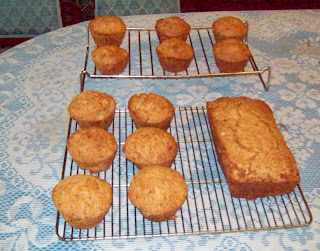
I found a recipe for zucchini bread. Again I adapted it a bit to our tastes. You can't even taste the zucchini in this. It's a tasty loaf with lemon and Cinnamon. It converts to muffin size with no problem. It's easy to toss a muffin at the kids when they insist they don't have time for breakfast, and since they are eating a muffin anyhow, they might as well have some juice. And hey, how 'bout cereal or an egg with that muffin? The muffins also go into lunch bags frequently. They freeze well, too. The bread is great with tea or coffee (and just a leeetle whipped cream). Easily warmed in the oven from frozen state, they're a life-saver when friends pop in for a cuppa.


Shredded zucchini freezes beautifully, no blanching, no mucking around. So far, no matter how big they get, I don't need to seed them or remove the membrane. I grate it in the food processor, divvy it up into freezer bags in two cup portions and I'm done. When I want to make a zucchini bread, it's ready. It' also great in olive oil with onions, garlic and a little bit of fresh ginger, takes all of 2 - 3 minutes to fry up. I throw it into chili or spaghetti sauce or use it in a stir-fry. I can puree it and use it in baking, substituting some of the liquid in the recipe. It adds nutritional value without adding the calories. It's mellow flavor works with any other flavoring and doesn't overtake the recipe.
And finally, they keep really well in my cold room. At least they do when they are the size of Louisville sluggers. By the time we ran out of zucchini that first year, it was January and I had only lost one or two to spoilage. So when I'm up to my eyeballs in teens, car pooling, harvesting, chickens, rabbits and their counterparts - dust bunnies, and whatever else gets thrown my way, I just pop them in the cold room. Sliced thick and dipped in batter, they fry up golden as the sun and still taste of the summer morn they were picked.

Friday, August 29, 2008

Late Summer On the DaM Farm

Early last week, I went out for one last look around before going to bed and something about the night made me think that late summer is here. I don't know what exactly it was, the dew was heavy and the air was past stillness. The signs have been here for a while; days a little shorter and the nights have lost their heat and humidity. Of course the harvest is coming in fast and furious, even my tomatoes are sporting the barest blush of red on their green skin. But it's always at night when I realize that it's late summer.

I always think of summer as a small boy. A little guy, may-be four - six years old. Summer here is like that wee fellow who has spent the day at the beach throwing sand in the air, chasing seagulls and splashing in the waves. By the end of the day, he sits on his oversized beachball, his toasted hand supporting his flushed face By his stillness and the deepness of his thought I know he's thinking of leaving. He's tired and spent, the warmth he has exuded all day is waning and a chill touches down as the sun sets on the waves.

So small boy Summer is having a last look around where he has had so much pleasure and brought life, laughter and joy. But he won't rush, he'll hang around for a little, waiting until he sees his red-headed sister making her way towards him. Late Summer and I both now wait for Autumn.


Thursday, August 28, 2008

The American Goldfinch or Hello Again!


Sometimes you don't know you're missing something until you see it again.

Before we moved out to BC, we lived in a house that had a large, southern living room window. I planted cosmos in front of it. That summer I delighted in sitting in the living room watching these tiny little yellow and black birds eat the cosmo seeds. I had no idea what they were, I just called them wild canaries.

I never saw this little yellow bird when I lived out west, probably because I was in a highly developed area and the only wildlife seemed to be teenagers.

I was just delighted one morning after moving into our old farmhouse to see one flit by. I planted cosmos in hopes it would attract them but it didn't work. I contented myself with the occassional sudden flash of yellow on a summer's day. Well, at least I knew they were here.

At the feed store this spring, I noticed these long mesh bags declaring that they were American Goldfinch feeders and for fun I bought one, filled it with seed and hung it off a crabapple tree by my butterfly garden. For a couple of weeks, it didn't attract anything. Occassionally the wind would push it back and forth, making it sway. Great - I now have a swing for the wind's amusement. Then one morning, there was a little yellow and black bird clinging to the side of the feed bag having breakfast! Soon word got out in the bird community and more little yellow and black birds showed up. Now I can watch five or six of them scramble for position on the bag while a few wait in the branches of the crabapple tree. It is an absolutely delightful way to spend 15 minutes while having my morning coffee.