Showing posts with label Doing Stuff with the Harvest. Show all posts

Thursday, December 30, 2010

Raw Dog food

Oooooh!!! Is that the food dish I hear rattling?!?!

I started making dog food about eight years ago. Dusk was my inspiration. We had him for about three months and by then I had done considerable research on his breed mix/type and the results were not good. Dogs of Dusk's origin, breeding and size don't live much past five years old and many do not get to three. I was feeding him a quality dog food that cost twice as much as the regular stuff but a serving was about a third of what I had to give compared to the grocery store brand so it wasn't as expensive as it looks at first glance. He got lots of socialization and excercise. So I was doing what I could and Dusk seemed happy and healthy.

At nine months Dusk started kind of favouring his hind quarters. He did a lot of 'bunny hopping' instead of running and sometimes had trouble getting up after a nap. Oh-oh. The vet said it looked like signs of hip displasia. Not good. She gave me some massage techniques to use with him and told me to limit the ball chasing/retrieval games since the stopping short wasn't good for H.D. My vet also suggested either home-cooking or raw food. She is a holistic vet, most vets are dead set against raw food for dogs. So I started looking into it. I did a lot of research but still it terrified me. I knew nothing about making a diet for my beloved pet that was going to be nutritious and healthy. A friend of mine and I were discussing this one day and I said I should really change Dusk to a homemade diet but I was pretty sure I'd end up killing him. She outright dismissed me, "You're not going to kill your dog". Here, go get this book, read and follow it and you'll be fine. And she was right. I was still halfway terrified and measured/weighed everything for well over two years. But after feeding this way for eight years and seeing Dusk approach his ninth birthday in good health, ( his back end gets a little stiff now and then) I'm glad I made the switch. I remember about a year after starting him on the diet watching all 130 pounds of him thunder across a field with a grace and strength he simply didn't have before. I couldn't help but marvel at the change in him.

Of course, food can only do so much. A really, really sick dog may not get better just because you change his food. But I do believe that a non-processed diet is just better for any living being. I suppose humans could live on nothing but cereal their entire lives, but who'd want to and how healthy would they ultimately be? Are there dangers to feeding raw food to dogs? Sure there are. I never leave the pets alone if they're having bones in case of choking. I use the same cleaning/preparation methods for their food as I do for cooking for the family. Other than green tripe, all the dogs food is human grade, so it's basically the same as ours (except it's the parts we don't eat). Green tripe is the stomach/intestines of cow, lamb or other herbivore. It's just gross, smells like a over-crowded barnyard that hasn't been cleaned in 50 years. I open the pack real fast and the dogs eat it outside. Horrid as it is, it's great for dogs and they absolutely go bonkers for it. So in short,I am aware there is risk but I believe the advantages outweigh it. Besides, the store bought dog food can be dangerous, too; remember all those recalls a couple of years ago?

A big bowl of veggie mush! I'll freeze this in little packages for the dogs' meals. A meal is mainly meat or meat and bones but a bit of veggies or fruit does seem to be required for my dogs. Dusk gets about 10% in his meal where Angel does well with 20 - 30%. I try to give the dogs as much variety as I can. Meats include chicken, rabbit, turkey necks, fish, beef, pork and on occasion goat and lamb and whatever else I can snag. Veggies are usually in a three or four combo mix and include dark, leafy vegetables and a little carrot or yam.


Mmmmm, garlic, ginger and parsley! When the dogs have veggies, I add this mix. Again, I make a load of it and then freeze it in single servings (I'm all about the easy and the convenient). I find it helps with digestion and my dogs breath/smell is not offensive at all. They do get other supplements, too; organic apple cider vinegar with their meat and bones meals, kelp/alfalfa with their meat meals, some oils like like wild salmon fish oil and early evening primrose oil though mind you, since now most of their meat is pasture fed, not grain fed they don't need as much. Dusk gets Vit. C to help when his hip displasia makes him stiff. They get raw organic ground pumpkin seed in the summer months to help prevent worms and fleas. I've never had an issue with either, yet.

Another important part of the meal is offal, the organs of whatever animal I happen to have, usually it's beef. This mix is heart, kidney, liver and tongue. They don't need much of it, but they do need it. We buy half a side of local, grass feed beef. I always ask for the organs and the trim that is usually thrown out and use it for the dogs. Of course, they have rabbit and chicken organs as well.

A nice, nutritious training/snack treat, dehydrated beef heart! The butcher usually throws in a couple of beef hearts along with the one that comes with my cow so I slice them thinly and dry them out in the oven. That plate is a whole beef heart dehydrated.
OK, it's not part of the diet Per Se but my dogs love their liver brownie treats! They also get eggs and yogurt and assorted other foods may not be 'classified' as raw but it works for for them.

Obviously, research and learning is tantamount in the success of a non-processed diet. Here is the book and the email group that helped me the most.
Natural Nutrition for Dogs and Cats The Ultimate Diet
by Kymythy R. Schultze.

Wednesday, September 1, 2010

Basil Garlic Pickled Green Beans

Well, the beans are done! I have pulled the plants and the freezer has bags and bags of green and yellow beans. So I decided to make Basil Garlic Pickled Green Beans. It might sound less than appetizing but they do taste wonderful and the beans stay crunchy. I hate mushy pickles of any sort.

It's a very simple recipe but like most pickles, it is time consuming. I need about 25 beans per jar, 2 - 3 garlic cloves, basil leaves and peppercorns. The peppercorns are quick, open the jar, pour 'em out. Everything else needs to be picked, washed, chopped and/or peeled. The brine is simple and fast. The recipe says not to use softened water so I always buy a jug of water to make the pickled beans. I'm not crazy about bottled water but buying one jug once a year is something I can live with. I have tried to find out why I can't use softened water but can't find any info on it.

So I prepare the jars and put the flavours in the bottom. While I'm doing that, I get the water going in the canner and the water for the lids. It's taken me a couple of canning sessions to figure out when to get the water bath canner going. At first I started it way too late and was waiting forever for the water to boil while my jars sat on the counter. A propane stove would probably heat the water much faster, come to think of it. I do four jars at a time so the bottles stay hot.

After putting the garlic, basil and peppercorns in, I stuff 'em full of green beans. The beans need to be upright and cut to fit. I find it's easier to put the first half of the beans in with the jar on its side. After the jar is stuffed with beans, I pour the hot brine into the jars and put on the lids and rings. Then it's into the water canner for a bit.


Hot from the canner, I put them on a towel to cool completely. As the jars seal, I hear a satisfying 'pop'. If the lid is curved downward in the middle, the seal is good. Once they are cooled completely, I'll check the seal and store them. They need about four weeks for the flavours to blend and deepen. After that, it's great snack food with crackers and cheese or to serve with meals.

Sunday, August 29, 2010

Freezers, Pros and Cons

When we moved here, we brought with us a little, 4 foot long freezer. I am a 'sale' shopper so a freezer was handy for that. The previous owners of our house left a humongous freezer behind, one those ones where I'm pretty sure I can lie flat in (not that I would because I wouldn't want to give anybody any ideas around here). The freezer ran fine and came in handy when the garden started really producing. The nice thing about it is it's in the cold room and doesn't really turn on too much in the winter. Most people can't fill one freezer but last Autumn, both were jammed packed. Sometimes going down to get a roast was a foray that had me emptying half the freezer then leaning over head first, teetering on my toes and hoping I don't fall in. And if I did fall in, praying that the lid wouldn't slam shut on me as I lay unconsious having whacked my head on a frozen roast. Of course, if that did happen, it would be kind of poetic justice for the cow whose leg part I was looking for. So when Don mentioned that a fellow at work had a bunch of chicken stuff for sale and a freezer we went for a look. Ended up with all sorts of stuff, an incubator, a bunch of waterers and chick feeders and another four foot long freezer. What family needs three freezers!?!?! As it turns out, one who grows most of their own food and buys 1/2 an organic, pastured local cow twice a year. As well, feeds two large dogs a modified biologically appropriate raw food diet (and yes, I am aware that the acronym for that is B.A.R.F.)

But it's making me think. Three freezers, even though they don't run all the time are still consuming energy. And then there's all that plastic. Freezer bags are re-usable and I do tend to use other plastic bags as well. But I wonder just how environmentally sound all that plastic is. I probably wouldn't have given this a thought before moving here but the lifestyle does make one very environmentally conscious. And that awareness leads to one small change after another until I want to actually figure out a better way than having freezers multiplying like rabbits, so to speak.

I have a water bath canner so I do can tomatoes and pickles. I have looked into getting a pressure canner so I can do veggies too. The jars are re-usable and so are the rings. The lids can't be re-used and there's that pesky BPA thing with them too. But apparently there are solutions to that on the horizon from what I read. In any case, it's probably better than all the plastic and electricity 3 freezers need. But every pressure canner I looked at says do not use it on a glass top stove and guess what I have? I use my pressure cooker on the glass top with no problem but I guess it's different for canners. I think what I might start looking for is a used propane stove. Something I could set up in the fall on a temporary basis just to can. It's something I can think about and look through the classifieds, Used PEI, Kijiji... and may-be I can find a better way.

Tuesday, August 3, 2010

Bonkers for Basil

Nothing like a big bowl of freshly picked basil, it positively defines "fragrant".

My basil is growing wonderfully this year. I could say it's growing like weeds but after six years of gardening, this particular saying has lost all its appeal for me. I selected a seed pack that had a variety of basil types; regular, Thai, Vietnamese and a few others. Some look like little bushes and have smaller leaves, some are purple, all are tasty and scented beautifully. The great thing about having rabbits is that the basil never gets a chance to flower; I'm always taking the tops off to add to the rabbit greens. The plants thrive and become sturdy and bushy. The basil with the smaller leaves are perfect for the rabbits because they love to eat the stems as well as the leaves.
`
A few youngsters and a Mama enjoying basil. Mama is insisting they share.

A couple of days I ago, I figured I better harvest some for the humans before the rabbits ate it all. I love using fresh basil and it's a simple task to preserve it. I do so much drying that drying space is at a premium around here. I could freeze it on cookie sheets then bag it for later use. But I have to freeze it whole and use it whole but usually I don't want whole leaves in my sauces and stews. Thawed out whole basil no appeal at all, it fact, it's downright yucky... and slightly slimy so chopping it is not anything I want to do. I could mince it all up, add a little water and freeze it in ice cube trays. That works fine but it tends to spit and spittle when added to a hot pan. Luckily I came across an idea in one of my herb books that takes this method one step further and the result is just perfect for me. I mince up the basil in the food processor and then drizzle in olive oil as the basil spins. I add enough oil to make a runny paste. Then I freeze it in ice cube trays for a couple of days then transfer the cubes (freed from the cold confines of the trays) to a freezer bag, label it and I'm done lke dinner. When I'm frying or making sauces, stews, etc., I throw in a frozen cube for instant flavour in the pan! Tasty and simple make such a nice pairing, especially over spaghetti!

Fragrant memories of summer in the making! An ice cube tray of basiled oil ready for the freezer.

Saturday, February 6, 2010

Taking Stock

I decided to take a peek around the pantry, freezer and cold room to see how the old "planting enough from one season to the next" is working out. I don't think I'll quite get there but this will be the closest I've come so far. Things are on the right track.

Frozen Stuff: Still have carrots and snow peas; it looks like they'll last another couple - three months. They taste great and are superb on their own as a side dish and make stews and soups delish. Lots of frozen pumpkin and zucchini. They're the staples in my muffins and loafs. I also throw a bit in the dogs' dish every now and then. They're going to last until the next harvest, for sure. There's still a little bit or corn-on-the-cob left, a few bags. Probably could have planted a bit more of that. Ran out of yellow & green beans. Well, I can't have everything... I will plant more next year because everybody likes them here and I like having extras to pickle.

Stored Stuff: I harvested about 1 1/2 feedbags of yellow onions. Still have about 1/2 a feed bag left. Boy are those suckers STRONG! They taste good, just a little goes a long way. They're hold up well, I might have had three that went bad on me so far. They'll probably last till June or so. About 20 pumpkins left. I do lose one or two every couple of weeks or so. They're just baked up and given to the chickens. I totally grew too many pumpkins.

Canned Stuff: Still have about 30 jars of tomatoes of various sizes left. They should go till next season. We have about 10 jars of salsa left, wouldn't kill me to put up another 12 or so next year. Tomato juice was a by-product of the salsa making, I'd drain the cut up peeled tomatoes before making salsa, it's all gone. So is the tomato sauce.

Pickles: Well, they're all gone except for the dills. I don't think there is a way that I could make enough to last one season to the next. They get eaten a lot here and make great gifts so I make what I can and then we just do without when they're gone.

Dried Stuff: Just about ran out of all the herbs and weeds I dried for the rabbits. Still have a bit of cornstalks, lemon balm and dandelion left but it will be gone this week, for sure. I still have a wee bit of herbs for us left.

So that's about it. I'd like to say all that hard work last summer was worth it but when I open a jar of my own salt free, organic tomatoes or bake up a scrumptious pumpkin bread , it's not the work I remember, it's the delightful, long summer days.

Friday, October 9, 2009

Making Salsa

We've just come off of two beautiful weeks of Autumn glory. The days were sunny and crisp, rosying my cheeks and warming my heart. It was a great time to work outside and enjoy the colour and the accomplishment. Sometimes life is just like biting into an apple.

Yesterday, the inevitable weather temper tantrum happened and kept me inside. Being in a warm home with a wood fire going made up for the rain and gusty winds. Looking outside at the flash of red in the old maple by the house turned the sky from a depressing grey curtain of cloud into a perfect backdrop

Well, if I can't be outside in the Autumn air with its indescribable crispness, I'll be in the kitchen, experiencing the 'other' Autumn smell as pumpkins, apples or tomatoes are processed for the winter. A lot of baking happens in the fall here at
the DaM Farm. But today I decided to make salsa. I always can my tomatoes first then if there's any left over, I'll make salsa. It was a great year for my tomatoes and I harvested about 11 - 12 bushels (listen to me, talking farmer talk - bushels!) so there was lots of extras. This is the third year I've made it but it's the first year I've done it from scratch. I used a package salsa canning mix previously. I looked around at various recipes and decided on a fairly simple one to start with, tomatoes, onions, garlic, cilantro and dried crushed red pepper. One of the recipes suggested that draining the tomatoes after cutting would make a thicker salsa. I love thick salsa and did find my salsa a bit on the runny side so I did that. I kept all the juice that I drained out and made tomato juice. I figure it will be great to add as liquid to the crock pot for roasts stews and making chicken or rabbit stock. I still have a load of tomatoes left so I will be making another batch of salsa. We love it here, 24 bottles is not too much at all.

Sunday, August 30, 2009

Pickles

The days are shorter and the nights are longer and both are much cooler. The green of the garden has been splashed with orange, red and yellow as the pumpkins, tomatoes and sunflowers show off their bounty. The beans and cucumbers are just about done and I have way too many. Sure signs of both a great growing season and pickling time. Whoot. Love my pickles.

I never pickled a thing before I moved here. I had to learn in self-defence or get run-over by over-ripe cucumbers moldering on the floor. With the help of a friend who not only makes pickles but jams as well, my first forays was pretty much successful ~ nobody died of botulism and things tasted like they were supposed to.

I doubt if pickling would have been as easy or accomplished if I hadn't a mentor who didn't mind me calling every 10 minutes to ask questions like "Does the brown sugar have to be packed down when I measure? Do I rinse the salt off after draining? How much water should I put in the canner?" In short I was clueless and she was very patient.

Aside from making bread and butter pickles and an awesome mustard relish, both recipes provided by the above mentioned pal, I have discovered you can pickle beans and carrots. There is one recipe I found that uses green beans, garlic and basil. Every time we are invited to a pot-luck I am asked to bring a jar of "those beans". The dilled yellow beans are pretty good and the cinnamon carrots bring an unexpected dash of colour and flavour to otherwise rather plain meals. This year I'm trying something new, dill pickles. As with all my other pickles, I'll try them first and if I don't die of food poisoning or pickle over/under flavourness, I'll serve them to others.

Friday, August 21, 2009

Pretty Comfrey


Five years ago a friend asked me if I wanted a clump of comfrey for my garden. I asked her what comfrey was used for. She answered, "Oh this and that. It comes in pretty handy in most circumstances." I took the comfrey, not quite knowing what to do with it. Now I can't ever see being without it, talk about a plant that can multi-task!

Way back when, comfrey was commonly known as 'knitbone' and 'woundwort' because of its healing properties when it came to broken bones, sprains and bruises. I always have a jar of dried comfrey leaves to steep in boiled water for stubbed toes, bumped knees and so forth. For broken bones, I much prefer casts and slings but when my daughter broke her collar bone and a cast couldn't be used, a comfrey poultice came in pretty handy after a bath and before she put her sling on.
`
The kind of comfrey I have is commonly known as Canadian Comfrey and grows quite high, I can cut it down three times a year easy. Which is good because I use a lot of it. A couple of times through the summer I will take a big black garbage can and fill it with cut comfrey, add water, put the lid on tight and let it sit for three weeks. Occasionally, I will give it a stir with a rake or pitchfork just to keep everything aerated. After three weeks, that garbage can just reeks! I have to steady myself and steel my nerves before opening the lid, it's one of the worst smells I have ever encountered. But it's a great liquid fertilizer for my garden, it does wonders for my corn and tomatoes. I take a shower afterwards and leave my rubber boots outside until they stop smelling, that takes about a week. The garden will smell funny a few days too but the plants just love their comfrey tea.

Comfrey also comes in handy for the rabbits. Usually my rabbits will ignore comfrey if I put it in with their greens. But if a bunny is not feeling well, she will eat comfrey if her ailment is a digestive issue. So comfrey helps me diagnose the problem and helps in tummy troubles.

Comfrey is a pretty plant. Mine will grow over five feet high and it sprouts new shoots easily, making it a breeze to propagate. I now have it growing in three different spots and when it gets too big, I cut it down and pop it in the compost box to add a little boost in nutrients. I gave a clump to a neighbour to grow since he was having trouble with an old shoulder injury. He has since started using it as a decorative plant. He says it makes a nice backdrop to his garden. I'm beginning to line one part of our old wooden fence with it and it does look very pretty with it's broad green leaves and delicate purple flowers. The flowers, pale and raindrop shaped, show up in little shy groups at the top of the plants. The dark green leaves brings out the weathered grey in the fence and adds a touch of strength to the washed out color.

Some people do use comfrey internally, usually in a tea or even salads. But a few years ago, a couple of studies came out saying when consistently fed to rats comfrey caused liver problems including cancer. Well hell, anything seems to cause cancer in rats if fed in high enough quantities as far as I can tell. Don't feed it to rats! All joking aside, I just use comfrey externally and avoid the whole issue. Comfrey certainly helps around here in many different ways. I guess I could say it makes life a little more 'comfreytable'.

Thursday, August 20, 2009

Drying Stuff or How My Dining Room Became a Jungle

When I was young, I remember house hunting with my parents. Mom (Eileen) always commented on the dining room. A house that had a dining room always moved to the top of the 'potential' list. I got the impression that a dining room added class, prestige and a touch of style. Not in my house, it doesn't, not anymore anyhow. Functionality has overtaken showmanship.

This is a picture of the door of my dining room that leads into the kitchen. Right now you can actually see it. In about two weeks, you won't be able to. I doubt very much if you'd be able to look out the window or the french doors. The table, a beautiful mahogany oval that can sit eight very comfortably will be covered with seeds and pods drying for next Spring's planting. (That's kind of depressing, thinking about next Spring already, so let's not.) In fact, getting through the dining room is going to be an exercise in strategic movement as we try to avoid drying racks and stray branches reaching out into doorways. When people tell you things stop growing once you pick them, don't believe them. I swear things that are hanging above doorways get longer and the next thing you know, they grab you by the hair. Or it could be I do a lousy job tying them up and the knots get loose and the string drops a bit.
`
The dining room became my makeshift drying room because it's the only room the works. You need a dry, no direct sunlight room to dry stuff and the dining room is the only room that fits the bill. The only window is north facing and the french doors have the porch roof prevent direct sunlight. I suppose the living room would work but I don't even want to imagine the howls of protest if anything should come between the kids and the TV screen. The big kitchen has too much traffic and the little kitchen is too small. The basement is too damp. That leaves the dining room.
`
We're used to it, and don't even give it a second thought. The kids get a little bummed because if Mom has turned the dining room into an aromatic pit they may or may not be able to navigate it means that school must be getting close at hand. Visitors still do a double take when they see raspberry canes heaped on my old greenhouse frame, beans, nasturtiums and cornstalks drying from string, herbs here, there and everywhere. Sometimes I think I should have the Guns and Roses song "Welcome to the Jungle" playing when people come over, just to prepare them a little.

Friday, July 24, 2009

Freezing Raspberries

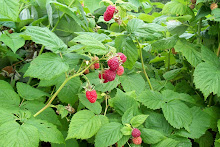
Unlike my strawberries which were a huge disappointment this year, the raspberries are wonderful. Raspberry canes just grow, produce for a couple of years and then die off but by then, they've replaced themselves twice over so there's always canes loaded with fruit. Raspberries are not a high-needs fruit. I like that.

I'm trying a different way to freeze them. I usually just pop 'em in bags and freeze. I found this method which says to freeze them on a cookie tray lined with wax paper then put them in bags for the long term. I'm hoping it will be easier to just get a scoop of berries in the dead of winter when I am longing for the long, hot berry days of summer. Heck when January rolls around, I'm even beginning to miss the mosquitoes. But back to freezing raspberries. Berries frozen in bags tend to stick together, I am hoping that if they're frozen individually they won't be so chummy with each other and will tumble merrily into my bowl reminding me of summer's carefree ways.

Friday, October 10, 2008

Canning tomatoes

I first started canning tomatoes back in the 80's. I was living in a suburb and a Farmer's Market had just opened. I noticed that at many stalls there would be huge boxes of over-ripe tomatoes growers were selling for next to nothing. That's when I decided to learn about canning tomatoes. I was thrilled with the results. The best part was I controlled exactly what went into the tomatoes, or more accurately, what didn't. No salt, no sugar, no extra water or flavorings. And I thought they tasted better, but that was probably just because I made them. Then I moved to the city, got a "real job" and canning tomatoes fell to the wayside.

Now, having a garden of my own, canning tomatoes is possible again. Rooting out all my canning supplies, I was surprised how well the canner and bottles had survived the years and countless moves. The biggest challenge was actually finding the equipment in a sea of rather dusty and worn boxes. Believe it or not, there were boxes that had never been opened in two or three moves.

Canning tomatoes is easy. This year I grew mostly Roma tomatoes, they are also known as Italian or plum tomatoes. They are the easiest to proccess because they peel so fast and in one clean step. Dip them in boiling water for about 30 seconds, drop 'em in cold water, fish 'em out, cut off the top, squeeze the bottom and voila, the tomato slips out with a plop and no mess. Their size and shape are perfect for canning, very little cutting or chopping is required.

So here they are all skinned and ready for the jars. Recommendations for canning have changed in the last 20 years. Now they say to cover the jars an inch over the top with water in the canner, when I first did them, the water just went up to the bottle necks. As well, lemon juice is added to the bottles before putting the tomatoes in. Apparently, tomatoes have less acidity in them then they used to (unlike some people I know who tend to get more acidic as they grow older). Back in the day, I always cold packed them. I did try hot packing them but it seemed like more work and time for no difference in the end anyways.

The biggest challenge are getting the tomatoes ripe. Our growing season is so short here, that by the time the first frost threatens, most of the tomatoes are just thinking of turning red. So I put them in boxes, layed between sheets of newspaper. I'm supposed to wrap each and every tomato in newspaper but what a pain when trying to find the ripe ones! A lot of unwrapping and wrapping goes on and by the time I get through the two hundred or so tomatoes, chances are a few more have ripened! The layers work pretty well. I do add a couple of apples to the boxes because it's supposed to help with the ripening. Anyhow, it doesn't take too long for them to ripe. What is really nice is that they don't all ripen at the same rate so I do a batch every now and then instead of having way too many to do all at once.

The best thing is that the canned tomatoes last from season to season. By the time I use the last jar of my tomatoes, new jars are all ready to take their place.

Monday, September 15, 2008

Calendulas


When I first started with Aromatherapy, I kept reading about the amazing healing and soothing powers of Calendula for skin. Unfortunately, there is no Calendula essential oil, just too hard to produce, I would think. A tiny little 20 gram tube of Calendula cream can set you back twenty or so dollars and wouldn't last all that long anyhow. So I learned to live without...until I got a garden. The plants themselves are very hardy and self-seeding. I can usually see them popping up around April, which is awfully early around here for anything to even start thinking of growing.

I found out Calendula flowers can easily be infused in oil. The oil absorbs the Calendula's healing properties and I can use it in remedies, lotions and creams. Most of my lotions and creams have about 20 - 50 per cent Calendula oil in them. I think it's great stuff.

Calendula flowers are easy to dry, just pick the whole flower and put 'em on newspaper until the petals practically fall off. They say the darker the petal, the more medicinal it is so I like the double, dark orange blooms. The only way I use them fresh is when my daughter needs some for her skin care. I steep some calendula petals in with some green tea and she uses it as a toner, it does seem to really help the problems of teenage skin. Sometimes for an extra boost, I'll add a couple of drops of lavender essential oil.

I find infusing them is a piece of cake. Once the petals are completely dried, I put them in a jar and top it off with organic cold pressed olive oil. Fresh petals can be used instead of dried but then I'm mucking around with trying to syphon off the water from the fresh petals and if I don't get it all, there can be a mold issue, which I'd rather not deal with. Once the petals are in the oil, I put the jar in on a sunny window sill and or on top of a heat vent and shake once a day. And voila, two weeks later, I have a lovely golden oil that pretty much will keep until the next harvest. All I do is strain it, squeezing every drop of that lovely oil out of the petals and keep it in the fridge.


disclaimer: This is how I use calendula for Aromatherapy, I am not recommending you do the same.

Saturday, August 30, 2008

Is That a Zucchini in Your Pocket or are You Just Happy to see Me?

Zucchinis are funny, I can look at them growing and think they are still a little too small, I go back a couple of days later and they are the size of baseball bats. Not only that, but because the leaves are so big and the stalks are so thick, I can easily miss the zucchini altogether until I trip over the darn thing. Just in case you're wondering, I put the 1 kg jar of peanut butter in the picture for scale.

The first year I was here, I saw some zucchini plants so I bought them, not knowing a thing about them. I had actually eaten it once in my life, at a restaurant. I really only bought them for something to stick in the garden. I figured they'd be like cucumber plants, just a little bit bigger, HA! I was amazed at how big they got! Their broad, dark green leaves were easily two feet across and I constantly mistook the stalks for zucchinis because they were so thick. Some of the plants were waist high. On top of that, I also discovered that six plants could feed a family of ten, I had 12 plants for a family of four, even I can do the math here. The next year, all my zuc plants died before even producing one little old zucchini. Talk about going from feast to famine. Since then, I've had a little success with them but nothing matching that first harvest ... until this year. I have 4 plants all producing nicely. I do try to harvest them before they get too big, but as you can see, I'm failing miserably.

So what does one do with zucchini anyhow? That first year's bounty forced me to become incredibly inventive with recipes. I have discovered how amazingly versatile this humble little veggie is.


One of the favorite ways we enjoy them is in a recipe I adapted and now call Zucchini Pie. It's very tasty, it has a base of cheese, eggs, cream and sour cream; there's tomato, garlic, onions, fresh basil, bread crumbs, Parmesan, and a bunch of other tasty things in it. It's great hot from the oven and cold on lunches. So, of course since it's so wonderful, it takes forever to make. The zucchini needs to sit in salt then rinse & dried, then brushed with oil and broiled. There's chopping, mincing and grating galore, not to mention making the yeast crust. Try as I might, I cannot make a zucchini pie in under four hours. So when I do make it, I double or triple the recipe, thus cutting down the time per pie considerably, takes me five hours to make 3, instead of 4 hours to make one. They freeze beautifully and I haven't taken one to a potluck where it wasn't a hit. It's also great to have them handy in the freezer for a quick meal or a side dish.


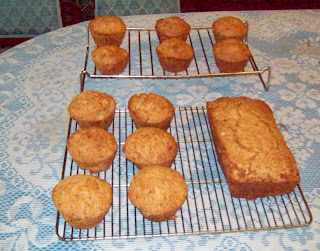
I found a recipe for zucchini bread. Again I adapted it a bit to our tastes. You can't even taste the zucchini in this. It's a tasty loaf with lemon and Cinnamon. It converts to muffin size with no problem. It's easy to toss a muffin at the kids when they insist they don't have time for breakfast, and since they are eating a muffin anyhow, they might as well have some juice. And hey, how 'bout cereal or an egg with that muffin? The muffins also go into lunch bags frequently. They freeze well, too. The bread is great with tea or coffee (and just a leeetle whipped cream). Easily warmed in the oven from frozen state, they're a life-saver when friends pop in for a cuppa.


Shredded zucchini freezes beautifully, no blanching, no mucking around. So far, no matter how big they get, I don't need to seed them or remove the membrane. I grate it in the food processor, divvy it up into freezer bags in two cup portions and I'm done. When I want to make a zucchini bread, it's ready. It' also great in olive oil with onions, garlic and a little bit of fresh ginger, takes all of 2 - 3 minutes to fry up. I throw it into chili or spaghetti sauce or use it in a stir-fry. I can puree it and use it in baking, substituting some of the liquid in the recipe. It adds nutritional value without adding the calories. It's mellow flavor works with any other flavoring and doesn't overtake the recipe.
And finally, they keep really well in my cold room. At least they do when they are the size of Louisville sluggers. By the time we ran out of zucchini that first year, it was January and I had only lost one or two to spoilage. So when I'm up to my eyeballs in teens, car pooling, harvesting, chickens, rabbits and their counterparts - dust bunnies, and whatever else gets thrown my way, I just pop them in the cold room. Sliced thick and dipped in batter, they fry up golden as the sun and still taste of the summer morn they were picked.