Thursday, August 28, 2008

The American Goldfinch or Hello Again!


Sometimes you don't know you're missing something until you see it again.

Before we moved out to BC, we lived in a house that had a large, southern living room window. I planted cosmos in front of it. That summer I delighted in sitting in the living room watching these tiny little yellow and black birds eat the cosmo seeds. I had no idea what they were, I just called them wild canaries.

I never saw this little yellow bird when I lived out west, probably because I was in a highly developed area and the only wildlife seemed to be teenagers.

I was just delighted one morning after moving into our old farmhouse to see one flit by. I planted cosmos in hopes it would attract them but it didn't work. I contented myself with the occassional sudden flash of yellow on a summer's day. Well, at least I knew they were here.

At the feed store this spring, I noticed these long mesh bags declaring that they were American Goldfinch feeders and for fun I bought one, filled it with seed and hung it off a crabapple tree by my butterfly garden. For a couple of weeks, it didn't attract anything. Occassionally the wind would push it back and forth, making it sway. Great - I now have a swing for the wind's amusement. Then one morning, there was a little yellow and black bird clinging to the side of the feed bag having breakfast! Soon word got out in the bird community and more little yellow and black birds showed up. Now I can watch five or six of them scramble for position on the bag while a few wait in the branches of the crabapple tree. It is an absolutely delightful way to spend 15 minutes while having my morning coffee.

Wednesday, August 27, 2008

They's A-Crowing!

My childhood memories of chickens were of dirty, smelly things. Their white feathers always had guck on them, they were forever running around in dirty water and drinking it. But the thing I remember most is that they were nasty; nasty to each other and nasty to humans, too. They ran away from them and squawked at them, and any chance they got, they'd peck at them. Of course, the chickens I saw were in zoos or petting farms and those situations weren't all that pleasant to begin with. Now seeing them in a environment more suited for them, I realize they are quite the little characters, full of fun and manageable mischief. The chickens spend their days out in the run, eating bugs and green apples that fall from the trees. They so enjoy dust baths and preening their feathers, staying clean and healthy. They come running to greet me, wings flapping, eyes bright and hop around my feet waiting for their treat.

I'm surprised at how easy to keep they are. I'm using the deep litter method in the coop. That means the wood chips are deep, at least 6 inches, and all you do is rake it up every couple of days or so, and add more when needed. This way the litter is only changed once or twice a year. It's working out great, very little smell and things seem to be clean - well, considering it is a chicken coop.

I built little stands for the two waterers and that was a great idea, the wood chips and other uckies stay out of the water so it stays fresh. I also built a feeder, just a long wooden box with and open edge at the bottom, it's got a built in stand to keep it up out of the chips as well. The box is big enough to pour in a whole 40 kg bag of feed. It's pretty good but the chickens like to stand on top of it so I'm constantly washing the lid. I'm hoping to make a few lids so I can change them and give them a really good disinfecting cleaning every so often. Don built beautiful nest boxes for them and I'm hoping to get them in the coop this week. It's still too early for the hens to be laying but we are all looking forward to our own farm fresh eggs!

In the morning, I can hear the roosters crowing. It's a soothing sound, not shrill or grating at all. It's low and mellow; and I can hear such joy and confidence resounding in their greeting of the sun. It's a new day and they're going to enjoy it to the fullest. Humans could take a lesson from that, must be darn near impossible to have a bad day if you welcome it with that kind of gusto and confidence.


This is Tobias, one of my Buff Orpington roos. He's a very dominant fellow and keeps everybody in line.


This is a Partridge Chantecler roo, he doesn't have a name yet, though under my breath, I call him Wimpy. He's very mellow and even the hens can boss him around. In fact, I'd say they delight in it. But he goes his own way and seems happy enough milling around with the rest.

Tuesday, August 5, 2008

Toads or Where are the Characters from "The Wind in the Willows" When You Need Them?

One thing that truly amazes me about growing my own food is how dramatically my interests have changed. Four years ago, bugs certainly weren't an interest now they are because bugs play a vital part in gardening. Same goes for worms, weeds, compost, compost tea, etc., the list goes on and on and on. I am evolving, much like the very plants I try to grow. Like roots sinking deeper in the fertile soil, I soak up information and facts trying to establish a firm hold in the earth of knowledge. Like branches stretching up towards the sun for nutrients and growth, I reach for experience and new understanding. Thank goodness this is all figurative, not literal otherwise I'd probably start looking like a stumpy tree.

Hence my interest in toads (shudder). Turns out toads (shudder) are great things to have in gardens for pest control. Toads eat bugs, lots and lots of bugs. You'll notice I'm not shuddering anymore, anything that eats destructive bugs is OK in my books. Growing up, I have read my share of cute little critter books, so the thought of toads hopping happily throughout my garden, munching bugs on their way through did hold its charm once I got over the shuddering reflex anytime the word 'toad' was mentioned.

I made two toad houses, one at either end of the garden. They are made out of strategically piled rocks in shady parts. I lined small stones on the ground for a floor. I do try to keep the area damp. Problem is the toad houses remain toadless (another thing evolving is my use of the English language). I know the DaM Farm has toads, I have seen them. They like to live under my front porch. The question now is how do I get those toads out to the garden? "Build it and They will Come" is not working here at all. I have played with the idea with catching a couple of them and putting them in the garden. But I don't know, if they wanted to be in the garden, I'd think they'd be there. I don't want to put them in there only to have them die or be hunted down. I was hoping the scarecrow I put up will encourage the toads to come since there are no crows around. I don't know if crows eat toads, I'm just guessing. So far, it hasn't worked. The toads seem to prefer wood shelters, the front porch, for example. I am planning to replace the flat rock roofs with leftover wooden boards from the chicken coop project. May-be that will help. How my interests have changed. I wonder if putting "toads" as an interest on my resume would be a good thing ...probably not, it would just "croak" my chances.

Monday, July 28, 2008

Raspberries

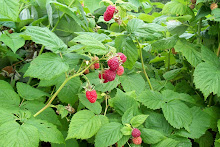
The rhythm in my garden is in motion. As the last strawberries wait to be picked, the first ripe raspberries make an appearance. And by the look of the snow peas flowers, they aren't too far behind. We've been eating leaf lettuce and baby beets for a while now. So the garden flows predicably to an extent. But I don't take it for granted; the raspberry cart or the snow pea bushel can be turned over by a whim of Nature.

The raspberries are good this year, very sweet and on the large size for my bushes. I think this year I'll have enough to freeze. Usually, we just eat 'em the same day they're picked; Nature's version of a drive-through resturant. But this year, it looks like we can have our raspberry and freeze it, too.

The great thing about raspberriy bushes is that they can be used in so many ways. First, naturally, there's the berries. Then after they are done, I add the leaves to my rabbits' food. In the fall, I cut the canes back and feed them to the rabbits who chew them up with gusto.

The raspberries are at the top of my main garden, next to the strawberries. And like strawberries, the raspberries' offshoots are springing up all over the place. I even have some poking merrily up through my lettuce and dill. So I'm thinking this fall, I might move the younger canes to the old wooden log fence that hems one side of the garden. The space by the fence always been overgrown since it is so hard to get in there to do anything. Plus I like the look of raspberries hanging over the fence. It looks so inviting and homey. So when the harvest is done and all I have left to do is look forward to a long winter, it will be nice to transplant the raspberries and know another spring is on her way.

Sunday, July 27, 2008

The Butterfly Garden

The Butterfly Garden was started as a joint project between T, then pre-teen daughter, and myself. I thought it would be a fun project for the two of us. We both were interested in seeing what kind of butterflies would show up. It has come with benefits; we’ve had marvelous conversations while weeding. While T has moved on to other interests the garden remains and she still will come out every now and then, pick a few weeds and talk. The topics, like butterflies, are varied and most times, as butterflies would, the topics flutter and float away. Some topics occasionally settle, like a butterfly alighting on a rock to sun itself; and becoming a real discussion of importance.

The Butterfly Garden originally was full of little white stone paths and almost everything in it was an annual. It was very pretty and whimsical. I put an old wagon wheel I found in a long forgotten corner of our property in it and scattered garden stepping stones and ornaments wherever I found a spot for them. But as daughters grow and change, so has the butterfly garden.

It's funny how one's priorities change when practicality moves in. It took me one summer to figure out while stone paths were very pretty; they were a royal pain to weed. The stones themselves kept migrating to the garden or worse, to the lawn where driving over them with the lawn mower turned them into flying missiles. I couldn’t use a trowel to loosen the weeds because of the stones. Only took one stone to the forehead to figure that one out. Now, instead of many trailing stone path, I have one down the center. I still have to weed it but I have found that adding a bag of stones every year is finally discouraging the weeds to the point where I’m hoping they’ll give up. I have applied the same philosophy to T, I don’t sweat the clothes she wears or the make up she applies because the grades are good, she’s not rude and does the chores. Like I said, priorities change.

After two summers, I realized I simply didn't have the time to plan, arrange and sow seeds every spring considering the other gardens I had to work on. So I started planting perennials that I heard attracted butterflies. I’ve got lambs’ ear, lavender, asterbies, lovage, and bee balm. The seeds I do plant of plants that are self-seeding and will come back, calendula and cone flowers. The ornaments and stepping-stones are more strewn now than placed. Any flaw I want to cover, I plop a knick-knack on it. Some of the time saved is now spent with T, and while I don’t want to cover her flaws, an occasional weeding of her attitude works wonders.

The Butterfly Garden has changed over the years, but it is still a gentle place, full of quiet beauty and sweet dreams, as is my daughter. And like my daughter, it has grown, becoming more practical and mature but the original charm, likability, and uniqueness have been kept beautifully.


Every now and then, there is an unexpected joy. Like this cosmo growing amoung the Calendulas. A seed from last year that persevered through the winter and grew strong and beautiful. Or T offering to shingle the top part of the chicken coop, conquering her fear of heights because she knew with my vertigo, it would be difficult for me. And so I carefully tend, nurture and occasionally put on a pile of tried and true compost, also known as advice. The gifts and the accomplishment come with the years.

Saturday, July 26, 2008

A Good Soaking

Generally speaking, it's been a long, dry summer so far. No gentle rains to wash the grit and grime away from the tired looking clover by the road. Without rain, everything outside tends to take on a brown sheen as the wind coats whatever it touches with a fine red dust found only on PEI. The humidity adds Nature's own cement and keeps the wind's painting job nicely stuck to objects. It looks like everything is sweating brown jewels. While the humidity is high, the ground is dry. The plants listlessly sit in the garden remembering damper days. Even my scarecrow looks thirsty.

Well that all changed yesterday. The remnants of some tropical storm edged by and generously dumped a load of liquid refreshment all over us. All afternoon the wind was restless. It alternated between obsessively chasing itself over the fields and through trees then disappearing completely letting the blazing sun broil the earth. I worked in the vegetable garden, pulling weeds, and progressively getting soggier as sweat tried to make up for the lack of rain. Where The Three Sisters are growing I carefully wove the sweet peas around the cornstalks hoping the gentle reminder would encourage them to latch on to the stalks and not each other. The clouds began to make a major appearance, throwing increasing grey patches of shadow to the ground; they ran through my garden and down the road. I scanned the sky for signs of rain. This has happened before; the sky would get all moody and touchy, have a fine old sulk, shed a couple fat drops,then get all sunny and happy again. Basically, a menopausal sky. I top dressed the three sisters with a combo of rabbit manure and compost. Hot and tired, I figured I'd wait till that night to water it in if it didn't rain.

Around five, the sky started grumbling. Rolling complaints and flashes of temper off to the west or southwest, may-be. I think. I am extremely directionally challenged and that's my best guess. If you are giving me driving directions, don't say "south" or "west", it's got to be "right" or "left" or I am going to get lost. Anyhow, the weather was off to my right when I was facing the house from the garden. As I watched the movement of the dark clouds, I sighed because it looked like it was going to pass us by. That's a funny thing about this island. You can watch the rain pour in the distance yet never get a drop yourself.

I had to go pick up my daughter from work. As I drove away, I left the dark brooding clouds behind and entered the sunny zone. Sigh. I so prefer rain to watering. Watering does the job and all, but it's a pain and call me crazy but the plants seem to prefer their water from the sky, not a hose. While waiting for my daughter, I called home and was told there were buckets of rain coming down. I drove right into the downpour going back home. Lightening flashed, thunder followed grumbling about the lightening showing off. Daughter ran inside squeaking only the way middle teens can - kind of a cross between a startled mouse and stepping on a cat's tail. I stood outside and enjoyed. It was cool, it was refreshing and I didn't have to fiddle with the hot/cold knobs to get the temperature just right. The garden shivered and trembled with joy. I swear if the corn could, they would have reached down with their long slender leaves, picked up their roots and danced. Welcome rain, soak in the ground and stay a while.

Sunday, July 20, 2008

Tomatoes and Basil

My poor, neglected gardens! With all my efforts being put on the chicken coop, my gardens have pretty much been left to fend for themselves. Other than occasionally throwing the hose in there to water, I've done very little in them. Believe it or not, the picture above is my tomato and basil garden. You don't want to see what the main garden looks like. At this point, I might as well call it my weed patch with the odd plant in it.

So yesterday, I rolled up my sleeves and got to work trying to at least find the plants. As always, I made some lovely and somewhat startling discoveries. I thought the weeding would take forever since it was so overgrown but the weeds being so big, it was a piece of cake. They pulled out easily, roots and all. The bigger the weed, the easier it is to yank out of the ground.

After I planted the tomatoes and basil, I noticed something was just having a field day eating them. I kept intending to mix up some neem oil, water and castile soap to spray on them but never got around to it. At one point, I thought for sure I was going to lose at least half of my 12 tomato plants. But lo and behold, all the plants fought back and held their ground; not one died. So imagine that, the gardens don't need constant supervision; they can grow all by themselves with very little intervention from me. I'm not quite sure how I feel about that. I take a lot of joy in my gardens and the fact they don't really need me is a hit to my self-importance. Ah well, pride before a fall and all that. Just a well deserved taking down a peg by Nature, not a bad thing. In fact, it really is a gift. It's always nice to learn more about where I belong in the great scheme of things.

I also discovered a whole bunch of tomato plants where I am absolutely sure I didn't plant any. In fact, I have about 20 tomato plants in there and I started with 12. I also noticed tomato plants in the main garden as well and I know I didn't plant any in there. They must have grown from seed in the compost. How curious! I tend to hot compost which supposedly kills any seeds. May-be some of the early compost I put on didn't have a chance really to heat up fully. I've put on my own compost in past years but this year it was almost solely mine (thank you, bunnies) so may-be that's why the tomato plants sprung up, just the overwhelming number made the survival of a few seeds a possibility. Another possibility is the type of tomato plant I had last year. I did have a variety, one being heritage tomatoes. I'm looking forward to see if that is what is springing up all over the place this year. I'm kind of thinking it might be the heritage tomatoes because they probably germinate better, not being hybrids and all twisted by the hand of man. I do have another theory, and I must admit, this is my favorite: Because I didn't weed for nearly a month, tiny tomato plants that would have been yanked up for being weeds actually had a chance to get a foothold in the garden. But if that was the case, you would think I'd have other plants popping on up, too. Radishes, beans, peas, corn... but no, just tomato plants.

After pulling the weeds, I had to do something about getting the sprawling plants off the ground a bit. Tomato cages don't work at all for me. Ultimately, the plants take exception to being confined and launch an all out grow assault all over the cages. The cages bend and buckle, bowing in defeat and my maters end up on the ground, rotting out. So this year I decided to use what was at hand, downed winter branches and baling twine from the hay bales. I made little teepees over each plant and loosely tied the dragging branches up. It sure looks jury rigged, but if it works, I'll probably do it again. So here's a picture of the garden after I was finished with it.


Look, you can actually see ground! The plants aren't spewing leaves and branches in all directions. But you know, I kind of like the first picture better, even if it wasn't as functional, the garden looked happier. I'll work on that for next year and use important lessons learned this year: Give the garden a chance to fight its own battles. Stop using the "Kill 'em all and let God sort 'em out" approach to weeding, weed less and let them get bigger. Have more heritage plants. A garden should be happy, not just a happy place.